Culture Without Builders
Conservatives talk endlessly about beauty and revitalising the arts, yet few serious — let alone large-scale — cultural institutions and projects are led or funded by them.

At the heart of today’s conservatism lies a curious paradox. Few political movement talk more about beauty, heritage, or civilisation. Yet few seem capable (or willing?) of creating, funding, or even seriously sustaining them. How is it that people who speak so loudly of the importance of restoring sanity within the art world are their most consistent absentees?
As I argued at the 2024 Postliberalism Conference and later in The Critic, one key aspect of the issue is the donors’ blind spot.1 Among the right-wing elite donor class, three attitudes prevail:
Indifference. Many on the Right see the arts as decorative or superfluous — a hobby for those who can afford it. They imagine that the market will somehow correct “woke art” by rewarding “commercial art”. But the high arts have never obeyed the laws of supply and demand. They have always required discernment, long-term patronage, and faith in things that don’t yield quarterly returns.
Risk-aversion. Wealthy conservatives may collect art or attend concerts, but they rarely build institutions. This is highly understandable, given the state of the art world and the radical ideologies many key agents in the field display constantly. But a retreat into private taste is unfortunately a sign of ignorance regarding how art’s prestige economy shapes civic life and even regime change — the very things right-wing people claim to want.
Cultural illiteracy. Deprived of an artistic education, many don’t know what good art looks like. And when they chase prestige, they generally outsource their taste to those who despise their politics and, while taking their bucks, these people don’t find it morally weird to severely judge their patrons for their beliefs.
[N.B. As I’ve already suggested above, there are obviously people who love and cherish the arts, and support them (e.g. by buying pieces, building beautifully, or occasionally donating money). And, of course, Right-Wing politics is a broad category: I don’t claim that right-wing radical counter-elites in America are the same as Scrutonian conservatives, Gaullist afficionados, or libertarians around the globe, etc. But I do believe that there are common trends across the spectrum, not the least in the elite donor class. And at the international level, I am yet to see one or several foundations that fundamentally deviate from the same stuff we keep seeing again and again, and provide a sustainable alternative.]
So, without financial fuel, online lamentations cannot go very far. In fact, right-wing thinkers and leaders must confront the awkward truth: reactionary performance is just as hollow as the state of the arts they keep worrying about. The louder the pushback grows, particularly online, the more it exposes how little many of its champions understand about art’s demands. Digital “traditionalists”, who recycle mosaics of saints and marble façades under the cry of “RETVRN”, exhibit the same fetish for posture and spectacle as the avant-garde and their apparatchiks they profess to despise.
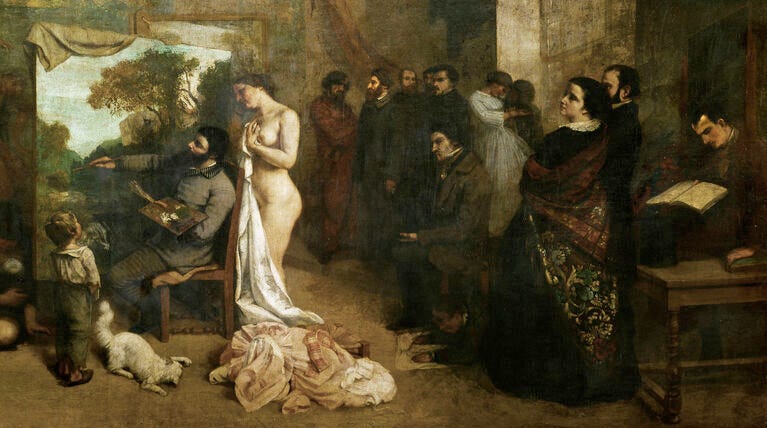
Detail of Gustave Courbet’s The Painter’s Studio (1855). Note the figure of Charles Baudelaire on the far right and patron Alfred Bruyas, the standing figure in the center.
The ultimate paradox, as Aaron Renn has noted, is that the landscapes and aesthetic forms conservatives romanticise, such as the Georgian terrace, the small-town square, or the artisanal workshop, are often preserved and inhabited by their political opponents.2 In practice, most of those who claim to revere these things have built almost nothing in their image, still less the philosophical coherence or patronage required to sustain a living culture. This is what Sumantra Maitra argues in a recent essay, in which he calls Conservative-sentimentalist aesthetic “hollow” because it’s more about “vibes”, symbols, and cul-de-sac nostalgia than substantive culture building (such as museums, craft industries, high-arts legacy institutions).3 I wholeheartedly agree with this particular passage:
“The new right, in particular, has a giant gaping cultural hole. It has, however, little to do with material causation, such as spending habits. The causality rather stems from a deeper philosophical angle. The new populist right in America, and increasingly in parts of Europe as well, are structurally or philosophically not designed to be imperial, cosmopolitan, or institutionalist: traits that are required to mirror the late 19th– and early 20th-century aesthetics and life they glorify. Incidentally, it is the cosmopolitan liberals, currently hopelessly politically adrift, unmoored from their traditional (and often benevolent) imperial instincts, due to a combination of demographic change and self-loathing politics of the last two decades, who are a much better defender of both progress and patrimony. This is not a judgment, simply an observation.”
Meanwhile, other political commentators retreat to a simplistic libertarian hostility to any state role. They see subsidies wasted on progressive causes and, understandably impatient in their wish to bring about reform, decide the state should categorically retreat, and refuse to plan a sustainable private-public patronage ecosystem. But the arts are not widgets. They cannot thrive on free market and “personal taste” logic alone. It also ignores the fact that the state cannot be agnostic about culture, precisely because it is the living expression of the principles sustaining our particular way of life.
The situation betrays something deeper: the Right does not understand culture well and does not know what to do with its wealth. Unfortunately, as many recent examples have reminded us, great wealth doesn’t guarantee great taste. Take, for instance, Elon Musk’s acquisition of a giant metal fork: an actual fork, albeit one standing over 30 feet tall, plonked outside X’s San Francisco headquarters in a gesture of such blinding literalism it makes Jeff Koons look subtle. Or Kanye West’s sartorial habit of presenting his wife in near-nudity, a perverse update on Renaissance portraiture for the Instagram age. The deranged masculinist aesthetic of Andrew Tate that verges on a parody of YMCA homosexuality. The pointless fashion experiments often observed at the annual Met Gala. Or the Bezos wardrobe. Hopefully, the point is made.
Of course, education plays a decisive role. When elite institutions still paid even token respect to the arts, they produced graduates who could at least understand — and sometimes sympathise with — conservative ideas about continuity and inheritance. In turn, many on the Right regarded the arts with the same respect they afforded other enduring institutions. Today, however, those same universities and schools tend to breed not sympathy but disdain — or at best, incomprehension — toward the Right. Meanwhile, they continue to supply both the educated public that funds the arts and the professionals who run them. Today’s cultural ecosystem is a rigged game.
This is not to say that all is lost. There are, and have always been, wealthy patrons who show real taste and cultivate it in others; those who understand the responsibility that accompanies influence. But the ascendant style of today’s cultural ruling class is neither classical nor truly avant-garde. It is sentimental, garish, incoherent, and above all middlebrow: allergic to both depth and discipline, yet desperate to be seen as original.
And as political leaders tend to abandon the issue entirely, thus the same worry continues to grow. That elites’ taste increasingly coalesces around being conspicuously “non-elite”, deliberately turning their back on anything with a flavour of the upper-middle-classes, even good taste or an appreciation of culture. No one is above that problem. Look at the way French Présidents used to build enduring monuments to culture (such as public libraries or museums) for posterity. Since Nicolas Sarkozy, this informal tradition has simply disappeared.
Even Emmanuel Macron, once fawned over by court journalists for his supposed communion with the arts (I remember a video of him holding a musical score while attending a concert — miles away from the “cool bruh” attitude displayed at the 2018 Fête de la Musique, or his patriotic enthusiasm for the illiterate and vulgar Aya Nakamura during the 2024 Olympic Games), has made a tactical retreat. Yes, rebuilding Notre-Dame and preparing the OG were both worthy projects (one perhaps more than the other), but they were circumstantial, i.e. not engineered by Macron himself, which feels a bit like cheating.
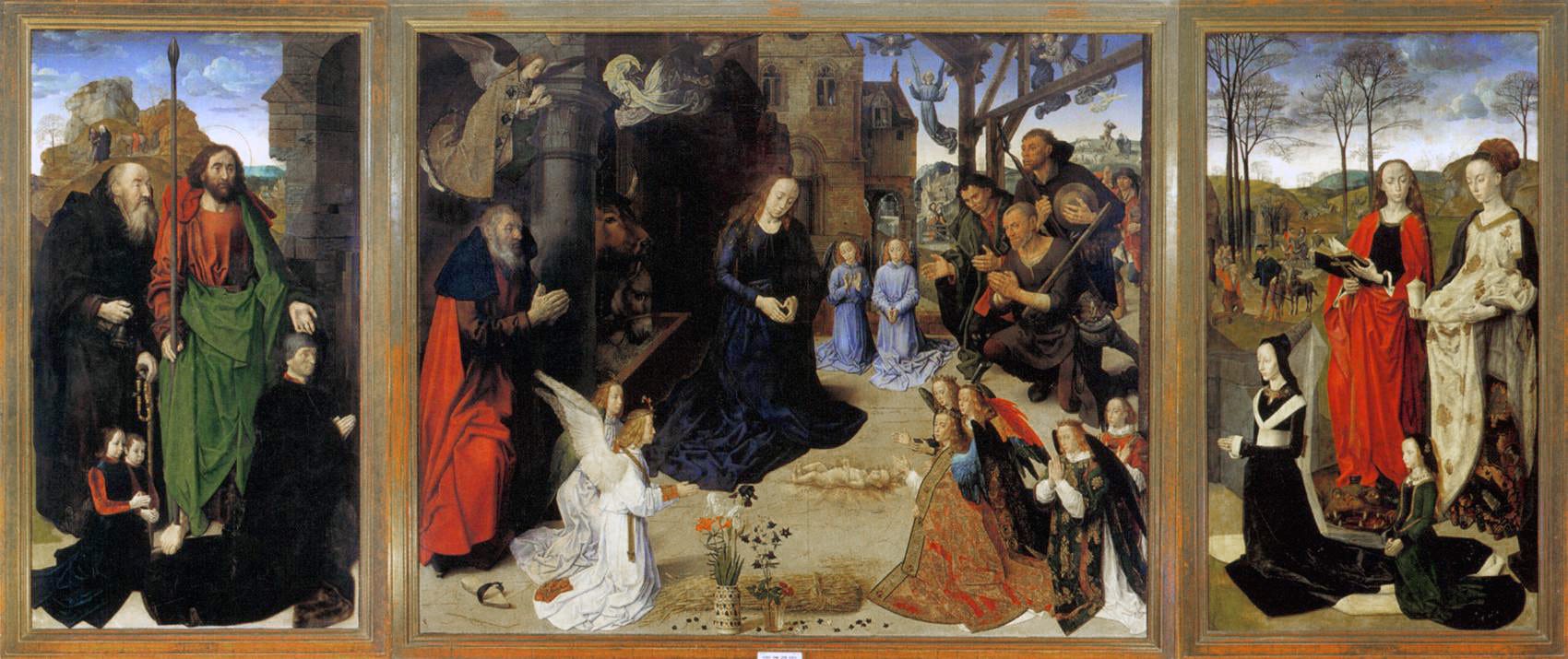
Hugo van der Goes, Portinari Altarpiece, 1476 and 1470, oil on panel, 253 cm x 586 cm (Uffizi Gallery). Tomasso Portinari, who worked for the Medici bank in Bruges, hired the northern artist Hugo van der Goes to paint a massive altarpiece of the Nativity for his home town of Florence, Italy. When put on display in the hospital church of Santa Maria Nuova in 1483, it created a sensation. All the while showcasing Portinari’s cosmopolitan sophistication, it heavily influenced the direction of Florentine art.
Last time I chatted with Curtis Yarvin about patronage, he used what I thought was a fairly good metaphor to explain how he saw the issue. It went something like this: right-wing leaders generally see the realm of philanthropic influence like a wine tasting club. Some don’t even want to get into it; others like to sip now and then for amusement. They’re oblivious to the fact that their political opponents are basically high-functioning alcoholics who cannot get enough of this stuff. Some of it is about sharpening your taste, but a lot of it has to do with controlling the means of cultural production: their cup must always overflow. And in order to fight it, you cannot just enjoy a few tasting sessions and give up to the cosyness of your penates. Your cup must runneth over as well.
So right-wing people tend to have patchwork worldviews with far more limited utility. Importantly, and I’m exploring this in a forthcoming essay for The Critic, there is an important psychological dimension here at play that is not talked about enough. Ego and identity dominate the discourse, and although the Right constantly attacks the Left on this ground, it has failed to recognised the plank in its own eye. In fact, it has no coherent cultural strategy to resist them. After decades of dysfunction, many treat their beliefs not as beliefs but as badges of status or membership in a subculture. To challenge those beliefs is no longer to dispute an idea but to assault an identity. Debate is not received as rational discourse, planning, or delivery; it is taken as a personal attack. In consequence, these issues no longer exist only as props for people to talk about themselves, instead of being discussed in their own right.
In afraid that the Left will remain better at this game so long as it is not met with the same appetite for power. But, of course, the Right should not misunderstand what’s needed here. Fighting the progressive illiberal stronghold over creativity and art creation doesn’t mean commissioning “Right-Wing Art”. It means intelligently backing intuitive people who understand art’s subtle power, and don’t reduce it to political mouthpiece (this would be in the realm of “artifice”, not “art”).
As a reader wrote to some comments I recently made on the topic, the Right doesn’t begin from a complete cultural vaccum. In the UK, for example, there are islands of serious patronage that still sort of work, such as college choirs commissioning new pieces (typically, the Coronation was a great showpiece, and I particularly likes Debbie Wiseman’s work); Glyndebourne stands firm; great charities represent real lifelines for serious artists, such as the Continuo Foundation for early music; patreon models fund great minds such as Samuel Andreyev’s. And, outside of the strict patronage bubble, good leaders prepare great things in the realm of literary publishing, for example.
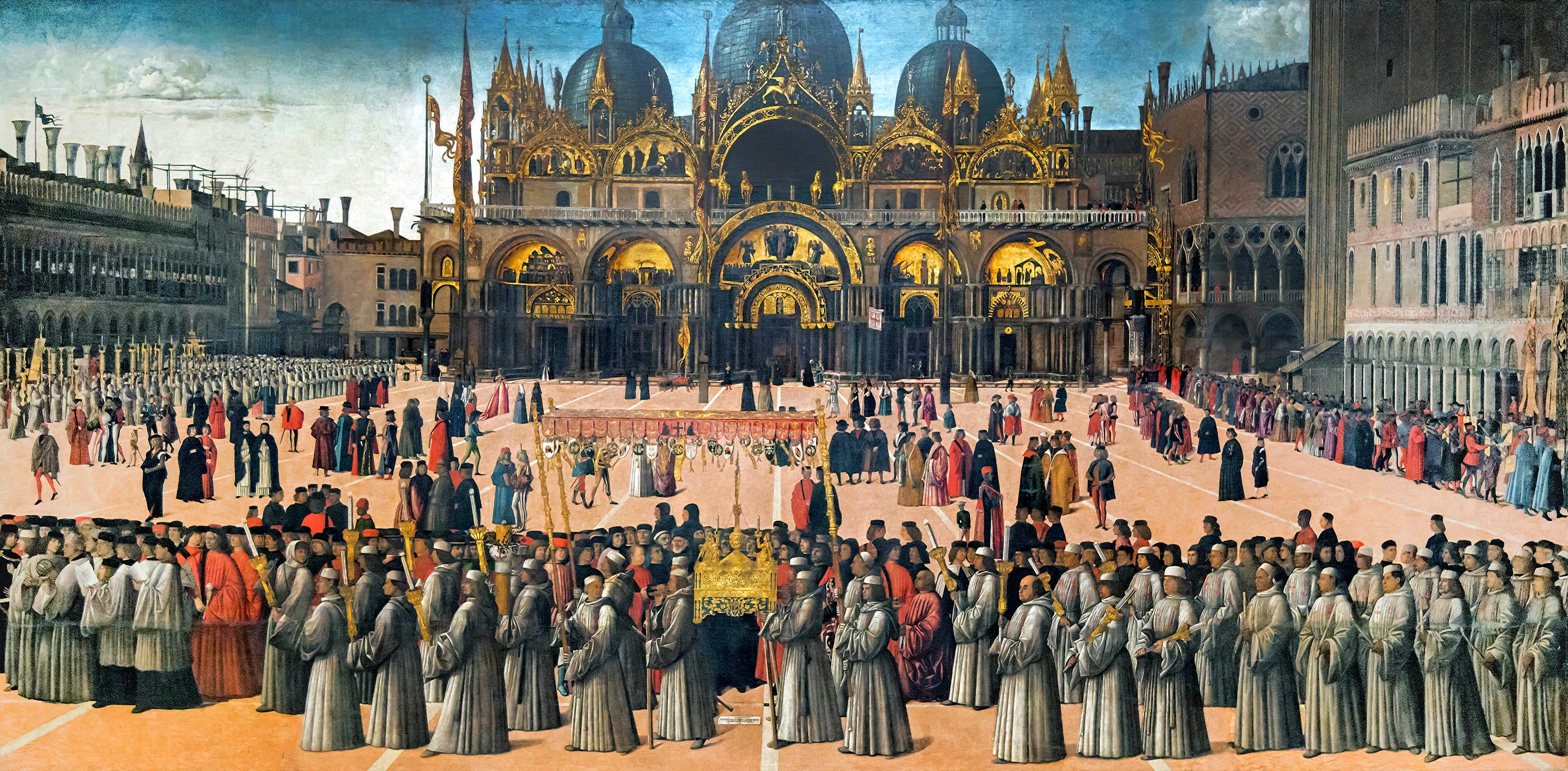
Gentile Bellini, Procession in St Mark’s Square, 1496, tempera on canvas, 347 x 770 cm (photo: Steven Zucker, CC: BY-NC-SA 3.0; Gallerie dell’Accademia, Venice)
Complaints have never built a civilisation. If those who speak of beauty and continuity wish to be taken seriously, they will have to recover the old habits of patience, discrimination, and generosity that once made art possible. Patronage is not a hobby for the sentimental; it is a form of responsibility, an act of faith in the permanence of things. The Left, whatever its excesses, understands that imagination requires investment. The Right still confuses its commentariat with a cultural class, and its nostalgia with a plan. And in the worse scenarios, the impatient and unimaginative will simply try to smash things down, only to realise a bit too late it will create a wider breach for their opponent to occupy with something even crazier than before.
Lola Salem, “Yes Beauty Matters - Now What?”, The Critic (March 2025).
Aaron M. Renn, “The Cultural Contradictions of Conservatism”, Compact (3 July 2025).
Sumantra Maitra, “The new right’s hollow aesthetic”, Engelsberg Ideas (8 July 2025).
IMO, the underlying problem is that “the right” has no coherent positive vision about anything. What political settlement does it support? What social arrangement? Is it egalitarian or in favour of hierarchical societies? Materialistic (searching for faster GDP growth) or some sort of “spiritual”?. Is it seriously or superficially religious, or perhaps atheist? Does it have a moral agenda?
Many of those incoherences tend to prevent any sort of organised or rivalrous effort to promote art. But the deepest problem is the near-total lack of shared and serious commitment to the Beauty, Truth, Goodness and so forth that Christianity bequeathed to our post-Christian quasi-civilisation.
A perennial problem. I'd just like to note a few other examples, however small in comparison with the libs, of conservative-friendly culture being nurtured, particularly by Catholics (who are of course not necessarily on the Right).
Driehaus Prize (trad architecture)
https://en.wikipedia.org/wiki/Driehaus_Architecture_Prize
https://driehausprize.nd.edu/laureates/
Scala conferences on art and beauty
https://scalafoundation.org/conferences/
Catholic Imagination Conference (poets and novelists)
https://www.luc.edu/ccih/events/partnerconferences/thecatholicimaginationconference/
Catholic Art Institute (visual art)
https://www.catholicartinstitute.org/conference2025
Trump's order on classical architecture is obviously consequential. Journals like the Claremont Review and the New Criterion praise good work where it exists. Conservative or at least unwoke music criticism comes from City Journal (Heather Mac Donald) and Substack (Don Baton). And it seems that once traditionally- or conservatively-minded creators achieve a certain degree of success, say in music (James MacMillan), sculpture (Sabin Howard or Alexander Stoddart), or architecture (Duncan Stroik), there are commissions there for them.
It seems that the philistinism of the "Right Wing Progressives" is a big problem because they are so wealthy and powerful, by comparison to the cultured, but economically marginal, tweedy trads.